SOLER Tools: Pitch-Angle Distribution and First-Order Anisotropy Tool

The SOLER project tools have once again made life easier for the scientific community by providing a tool to both visualise solar energetic particle (SEP) pitch-angle distributions (PADs) based on sectored measurements and calculate the first-order anisotropy using different methods. This is the 4th tool we’re introducing from the impressive list of SEP tools that SOLER has already developed. PADs provide researchers with vital analytical insight into SEP studies by indicating the direction of the particle measurements.
To start, the user selects a spacecraft and instrument from the available options along with the particle species and energy range. After selecting the date range, the tool downloads the data and plots a figure with various viewing directions and intensities, as seen in Fig. 1.
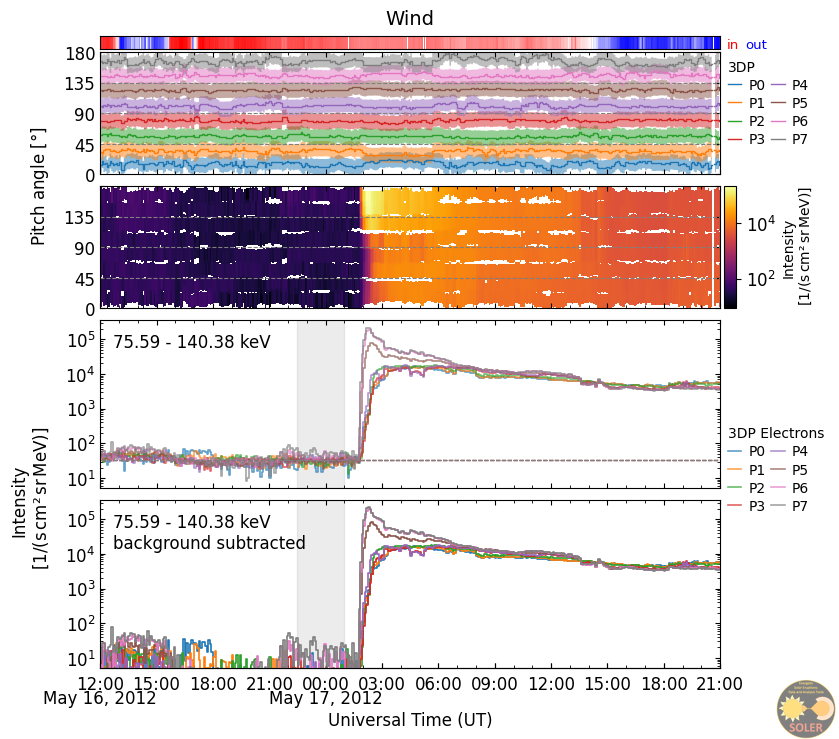
The next step removes the background intensity using the given background window, highlighted in grey in Fig. 1. The tool fits both a constant and an exponentially decaying model to the background intensity within this background window, and the result of this is used to remove the background intensity from the full time series using an extrapolation of the background fit.
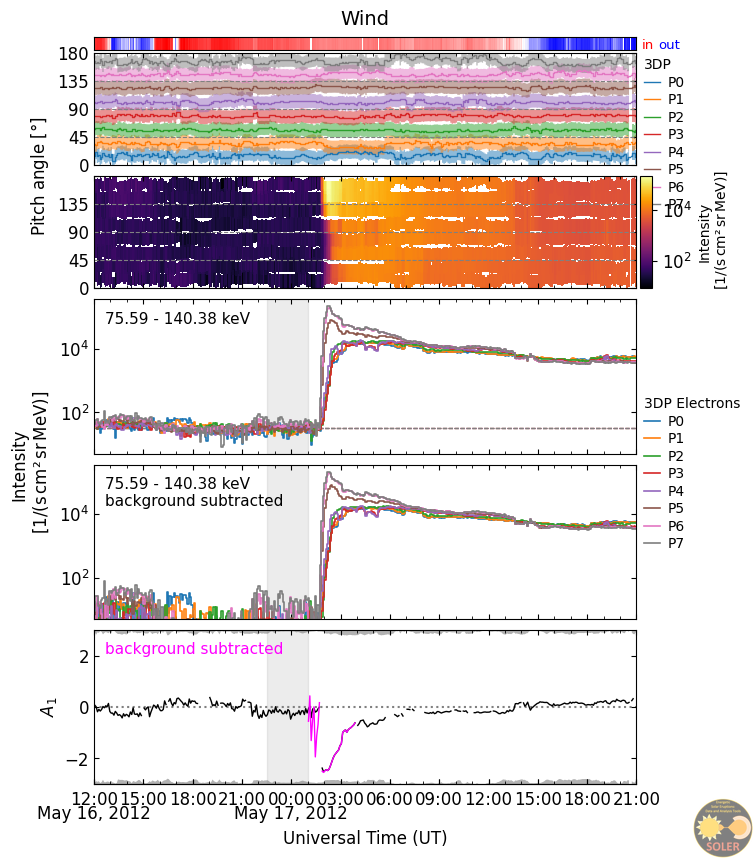
The third and final step of the notebook requires the user to select from three methods for calculating the anisotropy: the weighted-sum method, the weighted-sum method with bootstrapping, or the fit method. The weighted-sum method is described in Brüdern et al (2018, Central European Astrophysical Bulletin, Vol. 42, 2, 9). Adding ‘bootstrapping’ to this method simply implies a repetition of the method with bootstrapped intensity values based on the uncertainty values from the intensities. The fit method applies a 2nd order Legendre Polynomial fit to the PADs at each time step to determine the anisotropy. The resulting first-order anisotropy with and without background subtraction is then plotted in the final figure at the bottom, as seen in Fig. 2.
The tool was created by Laura Vuorinen, Nina Dresing, and colleagues at the Space Research Lab (Department of Physics and Astronomy, University of Turku).
To access the PADs and Anisotropy tool: