Observing the Sun from the Botanic Gardens with the Ruissalo Radio Antenna Array

The Sun produces the most powerful explosions in the solar system, often accompanied by fast particles with speeds comparable to the speed of light. These fast particles escape the solar atmosphere, and when they arrive at Earth, they can have a harmful impact on satellites and technology in space. However, there are ways of monitoring these explosions and particles directly from Earth before they arrive using radio observatories. One such observatory has recently been opened at the University of Turku (UTU) Botanical Gardens: the Ruissalo Radio Antenna Array.
The antenna array was commissioned in the summer of 2025 to monitor the sun during the day and other objects in the sky at night. The array aims to bring radio astronomy to Turku and also actively monitor space weather as part of the e-Callisto network, where real-time data from Ruissalo is available. Numerous solar radio bursts, lightning emission from local thunderstorms, and also echoes from meteorite trails have already been observed.
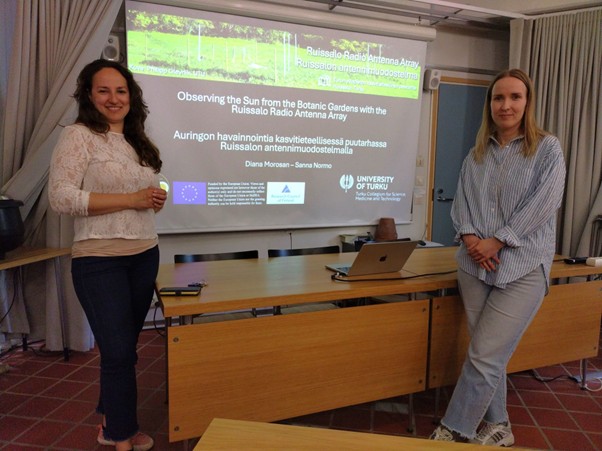
On 3 June 2026, researchers from UTU hosted a public launch of the Ruissalo Radio Antenna Array at the Botanical Gardens to share some of these new observations and the role of the Ruissalo Array in monitoring solar activity.
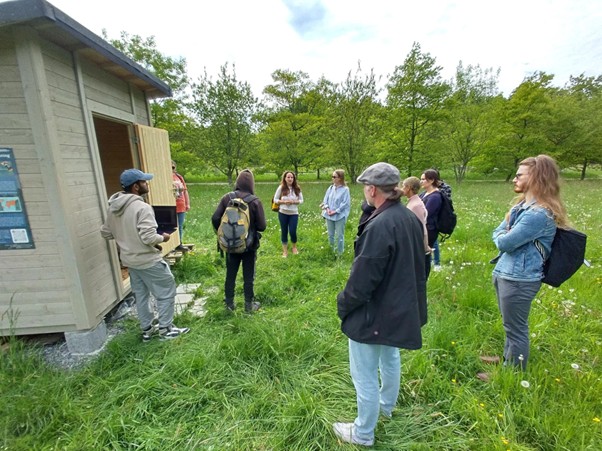
As part of the outreach event, an interactive activity was carried out by Karthik Bhandari in which a software-defined radio device was connected to one of the Ruissalo Mini Array antennas. The radio signals received by the antenna were converted into audio, allowing members of the public to listen to AM signals in real time. Since most traditional AM (medium-wave) broadcast transmitters in Europe have been shut down or significantly reduced in recent years, many of the signals that were heard were likely arriving from far outside the region. These distant signals can travel thousands of kilometres by reflecting off the ionosphere, a process known as skywave propagation.
Beyond its role in solar monitoring, the Ruissalo Radio Antenna Array will also provide valuable observations for the SOLER project. By delivering continuous, ground-based measurements, the array will help expand the observational data available to researchers and support ongoing space weather studies.
The instrument was spearheaded by Diana Morosan and her colleagues at the Space Research Lab (Department of Physics and Astronomy, University of Turku).
The array has been online since August 2025, and the data can be accessed from the e-Callisto website under FINLAND-RUISSALO.